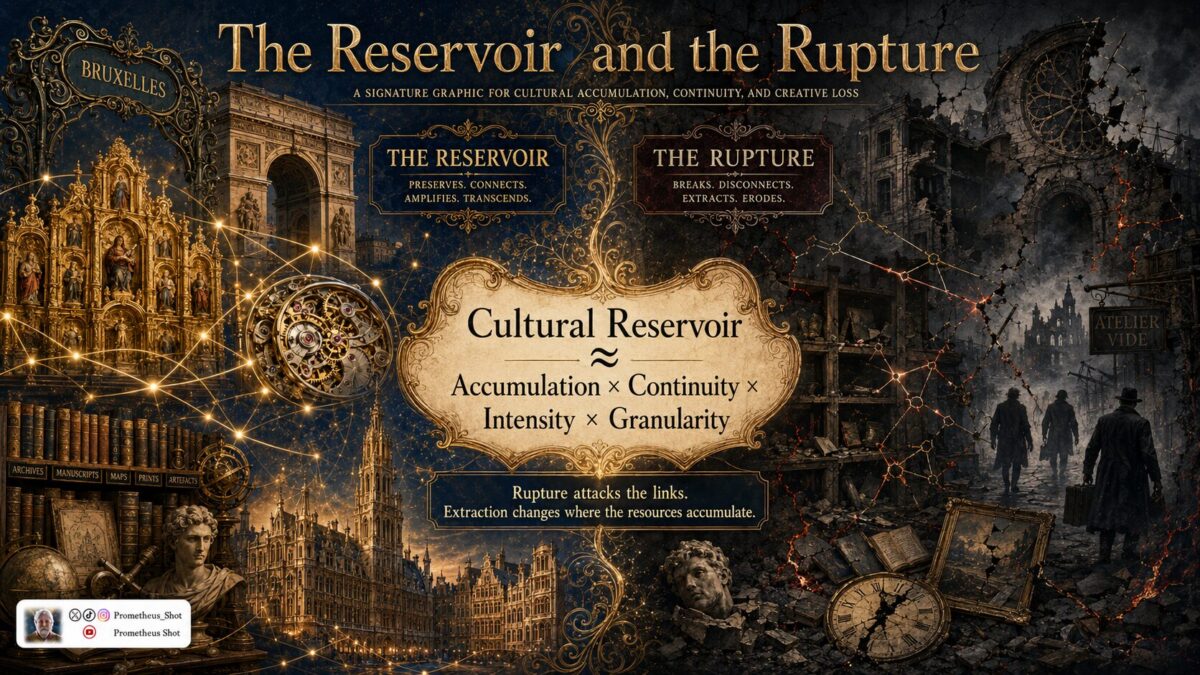
Excess, Cultural Accumulation, Creative Intensity, and the Legacy of Colonial Wealth
Cultural Resource Sets, the Reservoir, and the Ruin
I was walking through Brussels, following an Art Nouveau tour (Voicemap, by Derek Blyth), listening – surprised – to the fact that Brussels had 19 communes, as I crossed from one to the next, each with relative administrative freedoms (something very relevant to what I’ll discuss here) when I found myself lost in the meanings behind the elaborate, somehow rebellious, buildings…
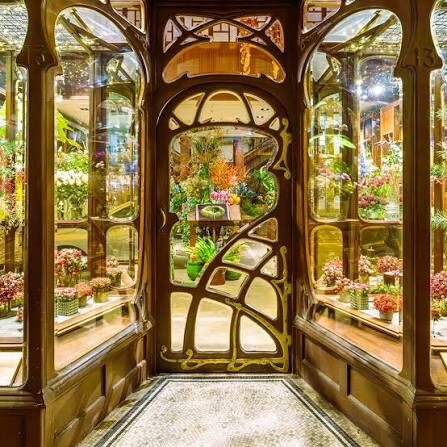
The unnecessary detail, rising against similitude and economy, suddenly looked like evidence of sorts. Someone could afford that curve, and that’s why they got them…
It was the same story, all over again. Beautiful, but not completely innocent. I remember feeling the same looking at the marble columns in Rome and the gilded churches in Spain.
That excess… Grand sometimes, symbolic sometimes…
But this particular balcony, in its relative recency, was more significant. It is not as direct a result of material excess, but rather the result of an intense prolonged accumulation and interaction.
Someone had learned how to make. Someone else had taught them. There was a design school, it interacted with other intellectual traditions. There had to be workshops, tools, architects, clients, schools, arguments about taste, suppliers of stone and metal, technologies for glass and iron, municipal regulations, skilled workers, critics, competitors—and enough accumulated wealth for somebody to say:
Yes. Make the door more beautiful than it needs to be.
But then something more significant had to happen.
The building had to survive. The communities had to survive. They had to interact with others.
A century later, people had to still care enough to clean it, restore it, write about it, classify it, protect it, and make an audio guide so that a stranger could walk underneath it and suddenly wonder why Europe looks like this.
That balcony was a condensation of time.
Beauty has a metabolism
We like explaining extraordinary beauty (or genius) through extraordinary individuals.
Michelangelo. Horta. Gaudí. Velázquez.
Genius is real.
It is also an incomplete explanation.
A creator never begins at zero. There is always a system, a group, a historical spirit of the times.
Everyone stands on the shoulders of giants… Giants without names.
Roman architects inherited arches, concrete technologies, engineering traditions and Greek forms. Medieval builders accumulated stoneworking, geometry and guild knowledge. Renaissance artists inherited classical fragments, Christian imagery, workshops and wealthy patrons. Baroque artists inherited all of that—and then pushed it toward theatrical excess. Later came Romanticism, Symbolism, Art Nouveau, Dada, Surrealism, Modernism…
One layer arguing with another. As they do, new meanings are born… Even before Hegel thought about that.
Human culture has what researchers of cumulative cultural evolution call a ratchet effect: modifications can survive their creators and become starting points for subsequent modifications. We do not merely invent. We inherit inventions that have already inherited inventions.
This is very close to what I have been trying to model through Cultural Resource Sets: culture not as a vague national personality, but as evolving networks of artifacts, meanings and identities. A cathedral, a watch, a myth, a painting style or a building technique can become a cultural resource because it carries more than its immediate function. It gathers associations, memories, legitimacy, emotions and identities—what I have called excess meaning.
A cultural resource is therefore both residue and seed.
Yesterday’s creation becomes tomorrow’s raw material.
And suddenly we have a possible mechanism for beauty:
material surplus → specialized work → creations → preservation → excess meaning → intensity → cultural resources → recombination & interaction → innovation → new creations
That is a machine for accumulation.

Rome: Conquest > Stone
Rome makes the uncomfortable causal relationship almost impossible to hide.
Scholarship on the Roman triumph documents temples, porticoes, arches and columns financed from manubiae—the proceeds of war booty. Maggie Popkin argues that Rome’s Mediterranean expansion generated a boom in triumphal building and helped drive architectural innovation; foreign conquest and foreign architectural vocabularies became embedded in the monumental city itself.
Conquered art travelled too. Greek statues and artworks entered Roman public space as trophies, turning parts of the city into spectacular galleries of accumulated conquest.
So when we admire Rome’s monumental density, we are looking at several kinds of accumulation simultaneously:
wealth accumulated as empire;
technical knowledge accumulated through construction;
forms accumulated from other cultures;
political meanings accumulated around monuments;
and, finally, centuries of preservation turning these structures into resources for everyone from Renaissance architects to tourists with smartphones.
Beauty has a genealogy.
And sometimes the marble remembers things our eyes would rather forget.


Accumulation is what happens when yesterday remains physically available to tomorrow.
Spain: Too much Gold!
Then there is Spain.
Anyone who has walked into some of its cathedrals knows the sensation: gold, carvings, chapels, sculpture, paintings, ornament piled on ornament until restraint itself seems vaguely impious.
I remember the stark contrast in the Mosque–Cathedral of Córdoba…
But the gold is not the argument.
The system around it is.
Seville is especially revealing. From 1503 until the eighteenth century, it occupied an extraordinary position in Spain’s trade with the Americas. UNESCO describes the Cathedral, Alcázar and Archivo de Indias as embodying not only Islamic and Christian Andalusian traditions but also the trading power Spain acquired through its American colonies; Seville became the “Gateway to the Indies” and the central port of that system.
That concentrated merchants, institutions, information, shipping, patrons, religious orders and international connections.
And it is obvious in the churches… This amount of extravagance makes no sense without colonialism and extraction.
Surplus creates possibility. Institutions direct it. Communities give it meaning. Specialists turn it into form.
Seventeenth-century Seville developed intensely collaborative artistic ecosystems involving painters, sculptors, altarpiece designers, plaster carvers, embroiderers, printmakers, writers and patrons. Amanda Wunder’s research on Baroque Seville documents major commissions of polychrome sculpture, richly embroidered religious images, monumental paintings and gilded altarpieces, produced through dense networks of specialist labor and patronage.
This was cultural flow—but under profoundly unequal relations of power.
I’d resist the tempting claim that every gilded Spanish altar can be traced directly to American bullion. Historical causality is rarely so tidy. Yet it is always there in the background.
The more defensible—and more interesting—claim is structural:
imperial systems helped concentrate extraordinary material resources and connectivity in certain European centers, and that surplus increased the space available for experimentation, waste, specialization, patronage and monumental production.
Colonialism helped distort the geography of accumulation.

Brussels: The money is not invisible.
Now return to Brussels.
Victor Horta’s Hôtel Solvay makes the benign side of the surplus argument almost embarrassingly clear.
It was commissioned by industrialist Armand Solvay. Brussels’ official tourism material notes that Horta effectively had almost unlimited financial means, allowing him to use precious woods and marbles and experiment technically with structure, light, space and integrated decoration.
There is the mechanism again:
industrial wealth → unusually generous creative possibility → technical experimentation → artistic innovation → preservation → canonical cultural resource.
But Brussels gives us the darker version almost next door.
Horta designed the Hôtel van Eetvelde for Edmond van Eetvelde, Secretary-General of Leopold II’s Congo Free State. Brussels’ own heritage authorities now explicitly discuss the building’s colonial materials—including exotic woods and ivory—and an official regional decolonisation report describes the house as having been conceived by Van Eetvelde partly as a propaganda instrument.
The connection extends beyond one mansion. The AfricaMuseum itself acknowledges that Leopold II created its predecessor as propaganda for his colonial project and that the later museum construction programme was financed from profits from his private domain in the Congo.


Here the sentence “every reservoir has an upstream” comes into focus, even though Belgium is relatively a minor colonialist country (not in terms of suffering incurred).
Some of Brussels’ visible cultural accumulation sits inside circuits connecting African extraction, Belgian capital, industrial technique, bourgeois ambition, architects, imported materials and artistic experimentation.
And yet reducing Art Nouveau to colonial extraction would make another bad approximation.
Its flowering involved industrial technology, craft traditions, creative communities, guilds, urban density, wealthy patrons, international influences, artists, architects, competing styles and a society negotiating modernity. The colonial dimension is additive and causal without being totalizing. That is the distinction worth preserving.


Geneva: a culture can accumulate in your hands
Accumulation does not always look like a palace.
Sometimes it ticks.
Geneva’s watchmaking tradition offers a beautiful miniature version of the same process, and with a (significantly) reduced colonialist dimension.
The traditional history—repeated by Switzerland’s official tourism body—combines two flows. Protestant Huguenot refugees brought portable watchmaking skills into sixteenth-century Geneva; meanwhile Calvinist restrictions on ostentatious jewelry pushed local goldsmiths toward other outlets for their craft. Metalworking, engraving, miniaturization, decorative finishing and luxury knowledge were redirected into horology.
The important point is that resources survived by migrating between Cultural Resource Sets.
Jewelry-making knowledge became watchmaking knowledge.
Workshops became industries.
Products accumulated reputation.
Reputation acquired excess meaning.
Eventually “Swiss watch” itself became a cultural resource.
Then the Japanese and American quartz revolution nearly demolished the system. Swiss watch-industry employment fell from almost 90,000 to roughly 30,000 between 1970 and 1988.
But accumulation now revealed another advantage: adaptive depth.
The Swiss did not preserve the tradition by freezing it. Quartz was adopted; Swatch reconceived the inexpensive watch as design, fashion and collectibility; mechanical watches were increasingly repositioned around craftsmanship, heritage, complications and symbolic value.
The reservoir contained more than one future.


Why Europe feels so dense
Accumulation explains depth.
But that’s not the whole story.
The other variable is intensity.
Difference is cheap to encounter here.
Brussels alone contains 19 communes. Cross a city boundary and administrative traditions change. Travel a few hours and languages, cuisines, architecture, religious histories, political memories and artistic schools begin changing.
Zoom outward and Europe becomes a strange mosaic of overlapping Cultural Resource Sets.
Romanesque. Gothic. Renaissance. Baroque. Romanticism. Symbolism. Art Nouveau. Dada. Surrealism.
Catholic and Protestant. Court and city. Guild and academy. French, Flemish, German, Italian, Spanish, Catalan, Swiss—and countless smaller local identities underneath.
Not merely diversity… It is more like ‘granularity’.
My current work on creative networks suggests why this may matter. Cultural Resource Sets appear to form small-world structures: locally dense clusters with permeable boundaries and short bridges to other clusters. Research outside my framework has found something similar in creative collaboration: Uzzi and Spiro’s study of Broadway showed that the structure of small-world creative networks influenced both artistic and commercial performance.
Creativity seems to need enough familiarity for ideas to connect—and enough difference for something surprising to happen.
In my terminology, this resembles Cultural Φ: integration meeting novelty.
Geographically, Europe often makes that encounter unusually inexpensive.
Difference sits nearby.

But Europe was destroyed too
There is an obvious objection.
Europe was hardly a paradise of uninterrupted continuity.
Its cities endured religious wars, revolutions, invasions, the Napoleonic wars, two world wars, ethnic cleansing, bombing and political collapse.
So continuity cannot mean “nothing bad happens.”
The better variable is something like the ratio between accumulation and rupture.
How much survives?
How quickly can institutions recover?
Are traditions preserved?
Do universities reopen?
Can displaced communities return?
Does a child inherit the workshop—or only a photograph of it?
Preservation itself is not passive. It is another creative act: someone must recognize value, decide to protect it, and spend resources maintaining it. In AIC terms, preservation requires Awareness, Intent and Creativeness simultaneously.
South Lebanon: when tomorrow keeps paying for yesterday
This is where the question stops being academic for me.
In South Lebanon, recurrent destruction by continuous / genocidal Israeli attacks changes the arithmetic of accumulation. The inverse side of the costs of a colonialist project.
A workshop surviving four generations does not merely remain a workshop. It develops tricks. Reputation. Relationships. Local styles. Apprentices. Suppliers. Stories.
Destroy it, and the loss is much greater than the price of rebuilding the walls.
You have destroyed connections.
UNDP now explicitly describes Lebanon as having undergone repeated cycles of war and reconstruction—including the israeli invasions and attacks 1980s, 2006 and 2024 (as usual, destroying significantly more civilian infrastructure and inflicting more civilian casualties than other ‘war-like’ goals)—that damaged infrastructure and cultural landscapes. The World Bank estimated physical damage from the 2023–24 conflict at about $6.8 billion nationwide, with housing alone suffering roughly $4.6 billion in damage.
The deeper loss is harder to put into dollars.
Instead of:
build → preserve → elaborate → specialize → reinterpret
a community can become trapped in:
build → destroy → mourn → emigrate → rebuild → destroy
The first cycle produces cumulative complexity.
The second repeatedly spends creativeness recovering yesterday’s baseline.
That is why underdevelopment can sometimes be understood not merely as lack of resources, but as the systematic prevention of accumulated complexity.
So why is Europe beautiful?
Europe’s extraordinary cultural density seems to emerge from an interacting system:
accumulation, because creations survived and became resources;
surplus, because societies could devote enormous labor to things beyond immediate survival;
continuity, because enough knowledge, communities and institutions persisted;
granularity, because distinctive traditions remained locally strong;
intensity, because those traditions encountered one another repeatedly;
selection and preservation, because some creations were canonized and returned to the cultural reservoir;
and, at important historical moments, conquest, empire and colonial extraction, which transferred extraordinary quantities of wealth, materials, objects and knowledge toward particular centers.
The last factor neither explains everything nor disappears because it makes us uncomfortable.
It changes the distribution of the reservoir.
That is what I would call accumulation asymmetry: some places accumulate partly through processes that reduce, appropriate or interrupt accumulation elsewhere.
Roman arches funded by conquest become humanity’s architectural vocabulary.
A colonial museum becomes a place where colonialism itself can be interrogated.
A Swiss watch born from religious constraint becomes an icon of craftsmanship.
An Art Nouveau house built for an industrialist becomes world heritage.
The artifact acquires layers.
Excess wealth becomes material excess.
Material excess becomes symbolic excess.
Symbolic excess becomes excess meaning.
Excess meaning becomes a resource for the next creator.
And perhaps this is the deeper political question hidden inside a beautiful Brussels balcony:
Who gets the right to accumulate time?
A school of art is time made language.
Culture is what happens when yesterday is allowed to become somebody else’s starting point.
Maybe civilization is not only the right to create.
Maybe it is also the right to leave something behind.
And perhaps this is where admiration should return—now less innocent, but deeper. Europe is not precious because it was uniquely virtuous, uniquely creative, or somehow exempt from the violence that made history. It is precious because, through centuries of accumulation, exchange, conflict, preservation, appropriation, reinvention, and extraordinary material surplus, it has become one of humanity’s densest cultural reservoirs. Its streets, museums, universities, workshops, cathedrals, libraries, paintings, music, philosophies, technologies, and living traditions contain resources gathered not only from Europeans, but from encounters (often subject to the whims of organized violence) with peoples and ideas from across the globe.
Much of that history demands criticism; some of it demands repair, yet the reservoir that resulted now exceeds the circumstances of its construction. A Roman arch, a Flemish painting, a Genevan watch, a Gothic cathedral, a Surrealist image, or an Enlightenment text can become a resource for anyone who encounters it. What was once accumulated locally can enter the common inheritance of humanity. Perhaps the responsibility that follows from Europe’s extraordinary accumulation is therefore not merely to preserve its treasures, but to open the reservoir: to acknowledge its upstreams honestly, preserve its granularity and difference, and allow the accumulated cultural wealth to circulate, recombine, and generate new worlds elsewhere.
There is another inheritance here too, one that makes the contradictions even more interesting. Europe did not merely accumulate objects; it accumulated arguments about what human beings are and what they owe one another. In the age of the Gaza genocide, much of this seems like talk, but this is partly why we have to stress it.
Humanism, the dignity of the individual, freedom of conscience, scientific inquiry, constitutional government, universal rights, equality before the law, and the idea that power itself must answer to principles were developed, contested, violated, revised, and institutionalized with unusual intensity within European intellectual history. They did not emerge from Europe alone, nor did Europeans consistently live by them—colonialism, slavery, fascism, religious persecution, and supporting wars in the middle east make any triumphalist story impossible. But perhaps that contradiction is itself part of the reservoir as it builds the great mirror.
Europe’s greatest treasure may therefore not be its gold, its monuments, or even its accumulated beauty, but the immense, unfinished conversation stored alongside them. A cultural reservoir becomes truly human when what it has accumulated is no longer merely something to possess, but something the whole world can use to think, question, create, and become more free.

References and Further Reading
On Ethereal Grounds — Hijazi & Sinha
Cultural resources, excess meaning, and innovation.
Read
Creativity as Fractal Memetic Attractor — Ahmad Hijazi
Cultural flow, networks, creativeness, and Cultural Φ.
Research Archive
The Cultural Innovation Sub-system — Ahmad Hijazi
Cultural industries as reusable innovation infrastructure.
Read
The Mask is the World — Ahmad Hijazi
Symbols accumulate meanings across people and generations.
Explore
Fuzzy on the Dark Side — Ahmad Hijazi
Approximation, culture, creativity, systems, and progress.
Explore
Country Brands as Cultural Resources — Ahmad Hijazi
Places accumulate meanings that reinforce future creations.
Read
The Human Adaptation for Culture — Michael Tomasello
Foundational account of cumulative culture’s ratchet effect.
Read
Ratcheting Up the Ratchet — Tennie et al.
Explains how culture preserves improvements across generations.
Read
Culture in Action — Ann Swidler
Culture as reusable tools, symbols, and repertoires.
Read
Collective Dynamics of Small-World Networks — Watts & Strogatz
Dense clusters plus bridges create powerful connectivity.
Read
Collaboration and Creativity — Uzzi & Spiro
Network structure can amplify or constrain creativity.
Read
The Architecture of the Roman Triumph — Maggie Popkin
Conquest, spoils, monuments, architecture, and collective memory.
Seville: Cathedral, Alcázar and Archivo de Indias — UNESCO
Imperial trade, cultural exchange, wealth, and monumental heritage.
Baroque Seville — Amanda Wunder
Patronage and specialist networks behind artistic flourishing.
Victor Horta’s Major Town Houses — UNESCO
Art Nouveau as integrated craft and architectural innovation.
Hôtel van Eetvelde — Urban Brussels
Art Nouveau materially entangled with Belgian colonialism.
AfricaMuseum — Museum History
Colonial extraction, collecting, architecture, and Belgian accumulation.
Explore
Swiss Watchmaking — Switzerland Tourism
Migration, goldsmithing, watchmaking, specialization, and adaptation.
Mechanical Watchmaking and Art Mechanics — UNESCO
Living craft sustained through intergenerational institutions and skills.
Explore
Swatch Group History
Quartz disruption followed by industrial and cultural reinvention.
Lebanon Rapid Damage and Needs Assessment — World Bank
Quantifies destruction, reconstruction needs, and repeated material loss.
The Great Divergence — Kenneth Pomeranz
Global resources complicate simple European-development explanations.
Empire of Cotton — Sven Beckert
Capitalism linked to empire, slavery, industry, and resources.
Explore
The Theft of History — Jack Goody
A major critique of Eurocentric historical narratives.
Explore
The Eastern Origins of Western Civilisation — John Hobson
Europe developed through extensive global cultural borrowing.
Explore

