
Reverse-engineering the mechanics of genius
Awareness, Intent & Creativeness — in action, in the real world.
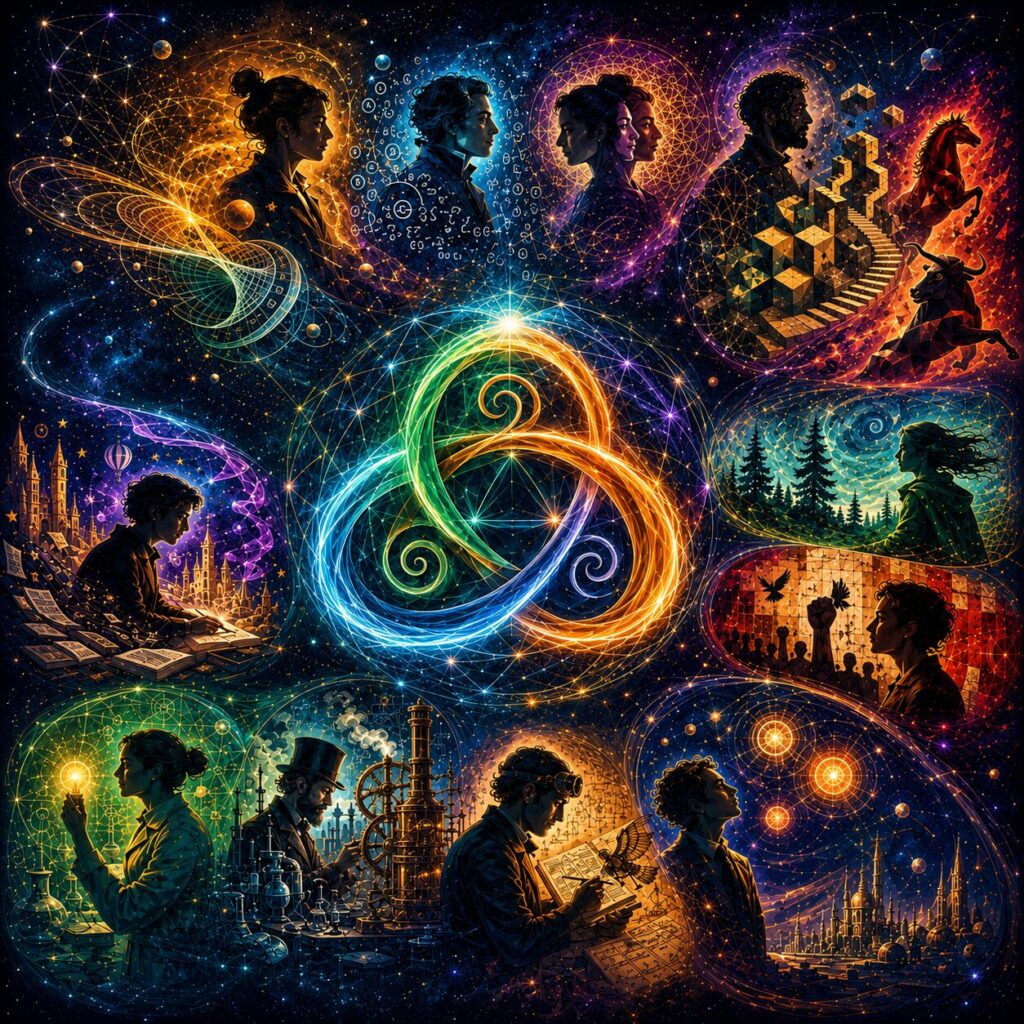
The Great Work Matrix is a set of masterclasses in Creativity, Innovation, and building meaning and enduring work, by looking at the cases of 12 people who have built lasting impact within and outside their fields.
What makes work truly great?
Not just famous / original / clever.
A Great Work changes how people see, feel, think, build, organize, imagine, or act.
The Great Work Matrix: Lessons from 12 Worldbuilders is a course about how that happens — through 12 powerful case studies from science, mathematics, psychology, art, animation, fiction, invention, innovation, and business.
We study Einstein, Ramanujan, Jung, Escher, Picasso, Miyazaki, Banksy, Cixin Liu, Leonardo da Vinci, James Watt, Thomas Edison, and Walt Disney — not as distant geniuses to worship, but as living case studies in how meaningful work is seen, shaped, built, shared, and scaled.
[ TLDR; check out the Udemy page]
Important Questions:
- What will you learn from the Great Work Matrix?
- Who is this course for?
- Watch the videos or take the course?
- What are the topics discussed?
A course about Great Work (not genius trivia)
Most stories about creativity are too simple.
They tell us Einstein was a genius. Picasso was original. Edison invented things. Disney had imagination. Banksy rebelled. Leonardo knew everything.
These stories are memorable, but incomplete.
Great Work does not usually come from a single flash of inspiration. It emerges from the interaction of many forces:
- what a person sees that others miss;
- what they choose, stand for, or become;
- what they repeatedly make, test, refine, and share;
- the symbols, stories, tools, and systems they use;
- the networks, markets, institutions, and audiences around them;
- the timing that allows the work to travel;
- and the shadow or cost hidden inside the work.
The Great Work Matrix gives you a language for seeing these patterns.
It is not a biography course.
It is a course about how Great Work happens.
12 Worldbuilders · 14 Sections · 66 Lectures · 5+ Hours · Hosted on Udemy
The core framework: Awareness, Intent & Creativeness
The course applies the central lens of my wider work:
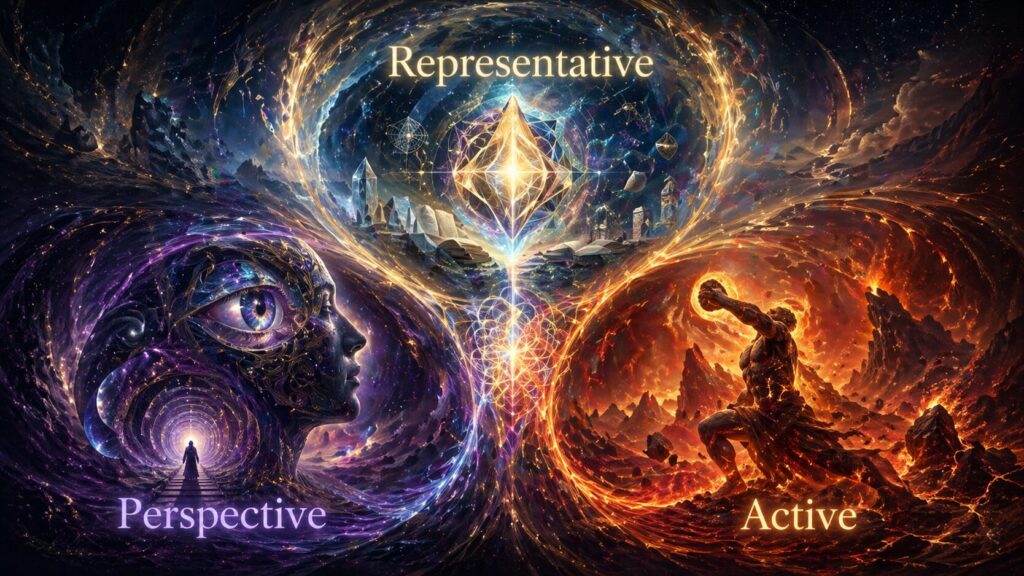
Awareness
What did they see that others missed?
Awareness is not just information. It is a higher-level outcome of knowledge. It is the ability to notice assumptions, patterns, contradictions, symbols, possibilities, limits, and hidden structures.
Einstein turned imagination into a knowledge tool — “seeing” physics by riding alongside a beam of light while others only calculated.
Banksy read public space and the attention economy as a medium, noticing that where and how a work appears can matter as much as the work itself.
Edison saw something stranger than any single device: that invention itself could be turned into a repeatable process.
Intent
What did they stand for, choose, or become?
Intent is the movement from planning to direction. It includes identity, will, courage, integration, purpose, and the choice to follow one path instead of many.
Jung broke from Freud to build his own map of the psyche, accepting isolation as the price of his own school.
Miyazaki defended soul, slowness, and hand-drawn craft against an industry racing toward shortcuts.
Watt committed to an efficiency problem the world believed was already solved, and held to it through years of frustration and debt.
Creativeness
How did they make it real in the world?
Creativeness is the worldly implementation of ideas through craft, discipline, output, systems, networks, resources, adoption, and scale.
Cixin Liu turned a private, scientific imagination into a global world, carried by translation, a Hugo Award, and international adaptation.
Picasso converted relentless output and total command of his media — and of his dealers and market — into a body of work no one could ignore, from thousands of pieces to the public force of Guernica.
Disney built imagination into infrastructure: studio, technology, parks, brand, and intellectual property.
Together, these three dimensions form a practical way to understand Great Work — and to examine your own.
[The three are discussed in detail in The Atlas of Worldly Wisdom]
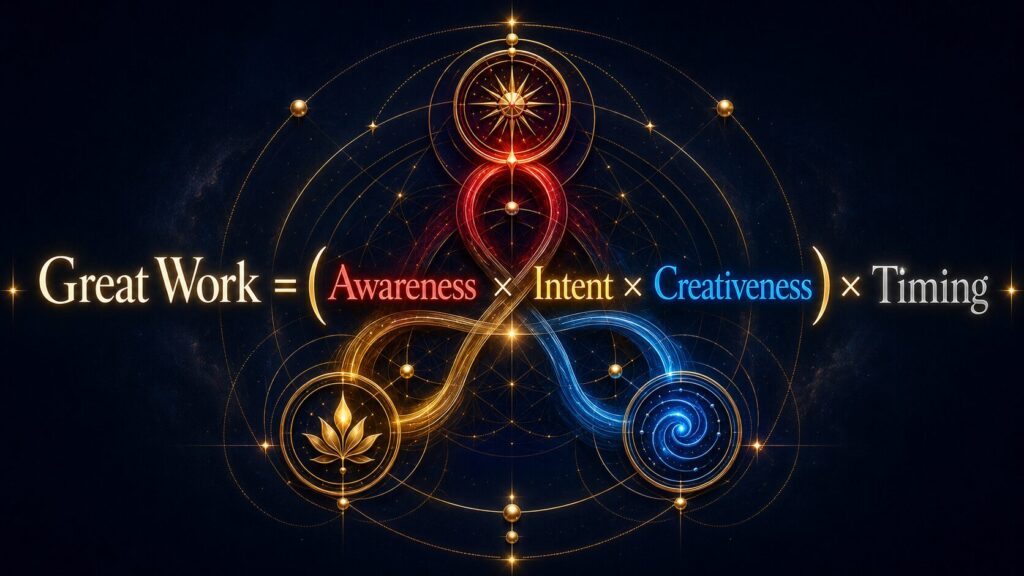
Great Work = (Awareness × Intent × Creativeness) × Timing
The three forces multiply — they do not add. Vision without execution is a notebook; execution without vision is busywork; and even finished work fails if the moment isn’t ready. A near-zero in any term pulls the whole result toward zero.
Timing sits outside the bracket because it is the one factor no individual fully commands — the historical window, the readiness of a field, the moment a work can finally travel. The other three you can build. Timing you can only read, meet, or miss.
Where The Great Work Matrix fits in the bigger ecosystem
The Great Work Matrix is one part of a larger body of work around wisdom, creativity, knowledge, action, and meaningful achievement.
The Atlas of Worldly Wisdom
The comprehensive map
The Atlas is the larger, encompassing framework. It asks:
What should I do now?
It is about learning, planning, action, habits, personal management, practical wisdom, and the integration of Awareness, Intent, and Creativeness in life and work.
The Edge of Knowledge
The theoretical background
The Edge of Knowledge asks:
Why is the world so difficult to know, predict, and control?
It explores uncertainty, incompleteness, approximation, beauty, chaos, complexity, and emergence — the deeper conditions that shape knowledge, creativity, and action.
The Great Work Matrix
The applied case-based bridge
The Great Work Matrix asks:
How have great worldbuilders actually done it?
It takes the logic of AIC and follows it into the real world: scientific breakthroughs, mathematical intuition, symbolic art, animated worlds, public rebellion, science fiction, invention, business systems, intellectual property, markets, and cultural impact.
If The Edge explores the difficulty of knowing, and the Atlas gives the broader map for acting wisely, The Great Work Matrix shows the framework alive in the work of people who changed fields, cultures, and worlds.
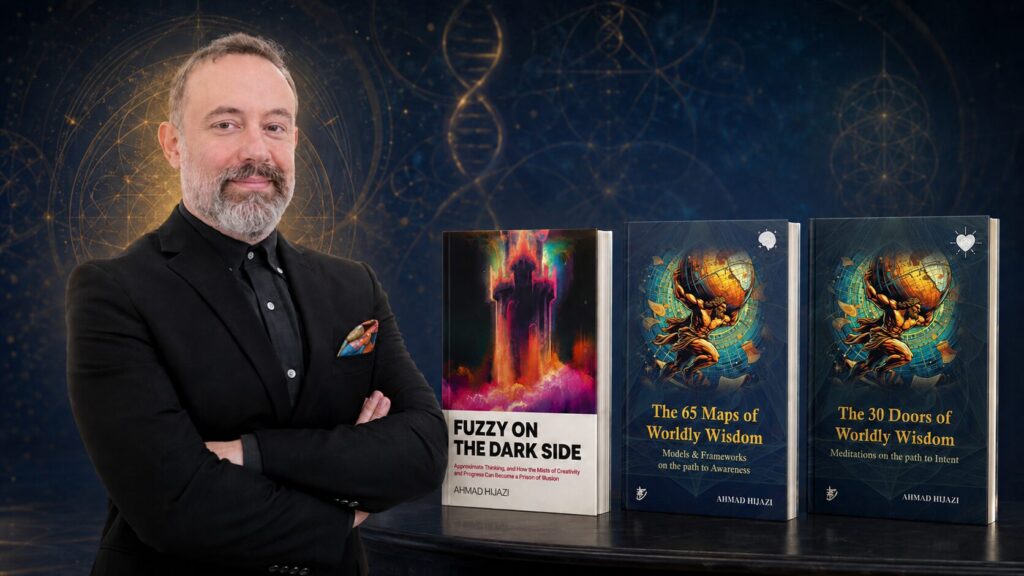
The Great Work Matrix course grows out of my broader work on Awareness, Intent, Creativeness, Approximate Thinking, cultural symbols, creativity, and practical wisdom. It is connected to The Atlas of Worldly Wisdom, The Edge of Knowledge, Fuzzy on the Dark Side, and The Prometheus Shot, but it is designed to stand alone as an applied journey (personal reflections and projects) through 12 cases of Great Work.
The 12 worldbuilders (Detailed Overview)
The course moves through three territories, with two bridge episodes between them.
Part I — Knowledge, Reality & the Edge of Seeing
Great Work begins when reality, the self, or knowledge itself becomes strange.
Einstein — How to see the problem differently before you solve it
Einstein shows how thought experiments, curiosity, imagination, and deep questioning can reshape knowledge itself.
Ramanujan — What to do with an intuition nobody else understands
Ramanujan shows the power of intuition, vocation, beauty, and obsession — but also the need for articulation, proof, mentorship, and legitimacy.
Jung — How to understand the hidden forces shaping your work
Jung shows how symbols, archetypes, shadow, dreams, and active imagination can become tools for inner knowledge and creative integration.
Bridge I — Perspective & the Impossible Middle
Escher — How to escape the category that does not fit you
Escher bridges knowledge and art. His impossible worlds show how perspective, abstraction, and contradiction can become creative engines.
Part II — Art, Symbols & Cultural World-Making
Great Work becomes a shared symbolic world.
Picasso & Guernica — How to stop waiting for original ideas
Picasso shows that originality is often recombination: the transformation of existing symbols, motifs, influences, and tensions into a new symbolic force.
Miyazaki — How to make work that feels alive
Miyazaki shows how personal vision, local culture, craft, slowness, ambiguity, and emotional truth can create worlds that feel universal.
Banksy — How to make people notice what you are trying to say
Banksy shows the power of symbolic compression, contrast, public space, anonymity, risk, and the attention economy.
Cixin Liu & The Three-Body Problem — How to build a world around a big idea
Cixin Liu shows how science fiction can materialize abstraction: physics becomes engineering, engineering becomes politics, and imagination becomes civilizational drama.
Bridge II — The Polymathic Workshop
Leonardo da Vinci — How to connect your scattered interests
Leonardo shows the power and danger of polymathic curiosity: notebooks, observation, experimentation, speculative design, unfinished projects, and the deep connection between fields.
Part III — Innovation, Systems & Scaled Creativeness
Great Work survives contact with markets, institutions, systems, and adoption.
James Watt — How useful ideas become revolutions
Watt shows why innovation is not simply invention. Ideas need efficiency, context, timing, capital, demand, and a system ready to adopt them.
Thomas Edison — How to turn creativity into a system
Edison shows systematic innovation: laboratories, teams, parallel experiments, patents, publicity, capital, execution — and the shadow of ruthless implementation.
Walt Disney — How imagination becomes an empire
Disney is the capstone. His story joins imagination, story, brand, intellectual property, technology, resource mobilization, detail, and scaled cultural experience.
Note : Some of these episodes can be found on the Prometheus YouTube channel
What you will learn
By the end of the course, you should be able to:
- understand Great Work beyond simplistic genius stories;
- use Awareness, Intent, and Creativeness to analyze creative and professional achievement;
- distinguish invention, innovation, adoption, influence, fame, and cultural durability;
- see how symbols, stories, style, routines, networks, institutions, and markets shape impact;
- recognize the shadow side of creative ambition, systems, brands, and execution;
- apply lessons from worldbuilders to your own book, brand, research, startup, course, artwork, organization, or body of work;
- build your own Great Work Matrix as a practical reflection tool.
Who this is for
This course is especially useful for:
Creators, writers, artists, designers, and filmmakers
If you care about originality, symbolism, world-building, voice, style, creative identity, and cultural meaning, this course gives you a deeper language for your work.
Entrepreneurs, founders, innovators, and builders
If you are trying to turn an idea into something useful, visible, adopted, and scalable, the course helps you think beyond the myth of the lone inventor.
Managers, leaders, consultants, and educators
If your work involves people, systems, knowledge, change, communication, creativity, or strategy, this course helps you see how ideas become real inside the world.
Students, researchers, and lifelong learners
If you enjoy big ideas across science, art, psychology, literature, innovation, and management, this course connects them into one practical map.
Reflective professionals building a body of work
If you are trying to build a portfolio, book, course, brand, research agenda, business, public voice, or long-term creative project, this course helps you ask better questions about your direction.
Why take the course on Udemy?
Some of the video lectures can be found on the Prometheus YouTube channel, but the full course is hosted on Udemy, built as a more structured learning experience: organized lectures, progress tracking, course materials, lifetime access according to Udemy’s terms, and a familiar platform for completing the full journey.
The Udemy course includes:
- 14 sections;
- 66 lectures;
- more than 5 hours of video;
- an introduction and conclusion;
- 12 worldbuilder case studies;
- reflection questions and applications;
- a practical final synthesis around your own Great Work Matrix.
How to use this course
Do not watch it passively.
Choose one project before you begin.
It could be a book, a business, a research paper, a course, a creative practice, a personal brand, a social project, an artistic direction, or a professional body of work.
As you move through the 12 worldbuilders, keep asking:
- What do I see that others miss?
- What do I stand for?
- What am I trying to make real?
- What symbols, tools, systems, networks, and resources do I need?
- What shadow or risk am I avoiding?
- What is the next concrete action?
The course is about Einstein, Ramanujan, Jung, Escher, Picasso, Miyazaki, Banksy, Cixin Liu, Leonardo, Watt, Edison, and Disney.
But the final question is about you.
What is your Great Work?
The wider path
The Great Work Matrix can be taken alone. It also works as a gateway into the broader ecosystem.
Go to The Edge of Knowledge if you want the deeper theory
Uncertainty. Incompleteness. Approximation. Beauty. Chaos. Complexity. Emergence.
Start with The Great Work Matrix if you want memorable applied cases
Worldbuilders. Creativity. Innovation. Symbols. Systems. Impact.
Go to The Atlas of Worldly Wisdom if you want the map of maps, applied personally
Learning. Planning. Action. Habits. Awareness. Intent. Creativeness. Practical wisdom.
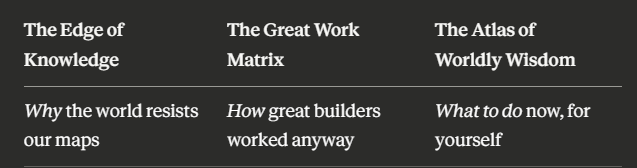
The three courses are connected, but each has its own role.
The Edge explains why the world resists our maps.
The Matrix shows how great creators acted inside that world.
The Atlas helps you build better maps and use them.
Begin the journey
Great Work is not magic.
It is seen, chosen, built, tested, shared, received, distorted, refined, and carried forward.
The Great Work Matrix is an invitation to study how 12 worldbuilders did this — and to use their stories as mirrors for your own work.