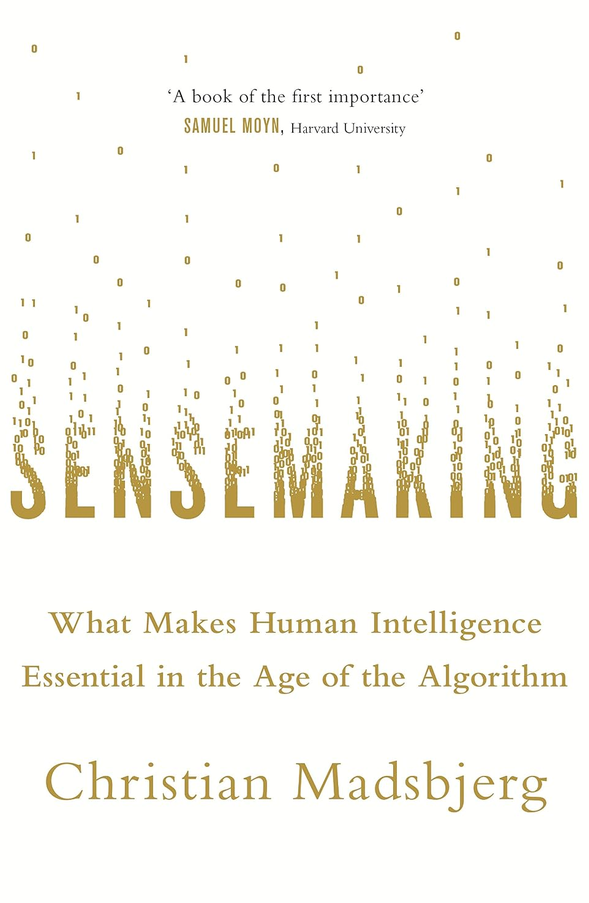
On Christian Madsbjerg’s Sensemaking
Book: Sensemaking: The Power of the Humanities in the Age of the Algorithm (2017)
Author: Christian Madsbjerg
Genre: Business, Philosophy, Anthropology, Management
Danish consultant Christian Madsbjerg’s Sensemaking is a defense of the humanities in an increasingly data-driven world. Its central argument is that facts and algorithms, regardless of their power, cannot replace an understanding of human experience, context, and meaning.
Madsbjerg offers five principles for developing this kind of understanding:
- Culture, not individuals. People don’t act in isolation. Their behavior reflects a wider system of shared meanings, traditions, assumptions, and social practices.
- Thick data, not just thin data. [Origin: Geertz : https://hci.stanford.edu/courses/cs376/private/readings/geertz_thick_description.pdf] Quantitative data tells us what happens. Thick data helps us understand why it matters, by considering history, relationships, experiences, and context.
- The savannah, not the zoo. Study people in their natural environments rather than through artificial, abstracted models that strip away complexity.
- Creativity, not manufacturing. Insight doesn’t always emerge from linear, analytical procedures. Imagination, openness, and abductive reasoning allow us to recognize unexpected relationships and develop new explanations.
- The North Star, not the GPS. Real understanding requires cultivated judgment and a sense of direction. Following instructions and accumulated data isn’t the same as knowing where to go.
These ideas draw on several important intellectual traditions. Martin Heidegger’s phenomenology emphasizes our inseparability from the world we inhabit. Aristotle’s phronesis, or practical wisdom, and Hubert Dreyfus’s work on expertise help explain why mastery goes beyond applying explicit rules. The book also invokes abductive reasoning, a form of explanatory inference associated with Charles Sanders Peirce.
Some examples in the book, particularly the contrast between winemaker Cathy Corison’s cultivated judgment and analytical approaches to winemaking were quite rich. The negotiation example too.
Culture is more than context
The underlying argument resonates with the emic versus etic distinction in anthropology: understanding a cultural world from within, rather than relying exclusively on external classifications.
It also connects closely with my research on Cultural Resource Sets (CRS).
A cultural object is never merely an object. It carries accumulated knowledge, values, identities, assumptions, and excess meaning. Its meaning comes partly from its relationships with other cultural resources and the people who use them.
In this sense, the Cultural Resource Sets framework attempts to model some of underlying relationships discussed systematically, through networks of artifacts, meanings, identities, and practices. These networks don’t merely explain behavior. They also influence possibilities for action and creativity, and evolve as people use and transform them.
There is another important qualification. Contextual understanding is itself incomplete. As I explore in Fuzzy on the Dark Side, our knowledge and judgments are inevitably approximate, shaped by identities, assumptions, and cultural affiliations, which can become elements of inertia and clouded judgement. Understanding a culture from within is valuable, but doesn’t automatically make our interpretations accurate.
The future belongs to meaning-makers?
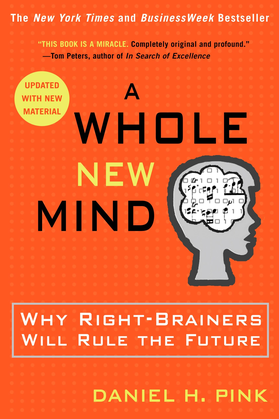
Madsbjerg’s argument belongs to a much wider discussion. In A Whole New Mind, Daniel H. Pink argued that automation and abundance would increase the value of design, storytelling, synthesis, empathy, and meaning. His predicted Conceptual Age bears a strong resemblance here.
The challenge is not only how to acquire and process knowledge, but how to transform knowledge into meaning and meaning into valuable action.
This is also central to my Atlas of Worldly Wisdom, where Awareness, Intent, and Creativeness must work together. Knowledge is necessary, but it is not enough. Human judgment, purpose, and the capacity to create remain central. After AI, where computation becomes cheaper and more abundant, human judgement and intent will only become more valuable.
And these concerns extend well beyond business, into science, education, administration, public policy, and the design of institutions.
A worthwhile argument, imperfectly delivered
Despite my agreement with much of the book, I found the treatment occasionally thin. Important philosophical traditions are simplified, sometimes without clear specification of how the humanities go into the work (besides the timeless advice about the importance of reading the classics).
Some personality profiles and anecdotes seem included awkwardly (the trainer or the bureaucrat for example). At times, the book resembles an extended advertisement for the author’s consulting practice, which has become common practice.
Cultural Φ evaluation [Creativeness]:
Integration [how much the work connects cultural resources] 8/10
Novelty [originality, distance between resources integrated] 7/10
Φ = I x N = 56/100