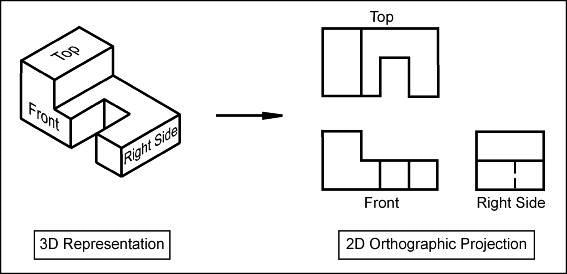
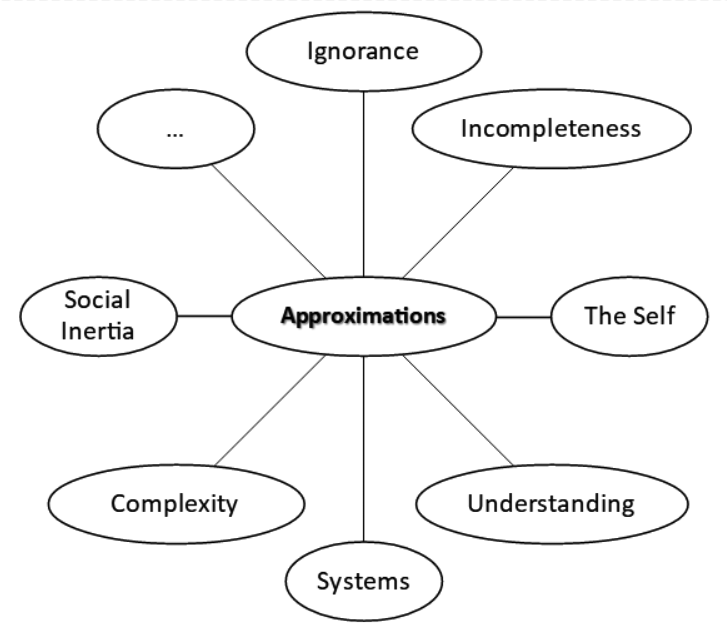
Approximate Thinking is when we understand, communicate, and act by substituting one thing for another: a model for reality, a label for a person, a measure for an achievement.
Developed in my Fuzzy on the Dark Side, it explores how these substitutions enable thought and creativity and produce illusions.
We do this because our knowledge is inevitably incomplete. We cannot consider everything, so we simplify. A map leaves out most of the territory to help us find our way. Trouble begins when we forget what it leaves out.
The compact expression is B = A + E: A is the reality / what we are trying to understand (active/material); B is what we use in its place (representative); E is the difference / error, including omissions, distortions, and assumptions (perspective).
Think of a CV standing in for someone’s capabilities, or busyness standing in for productive work. The substitution may help. The question is whether the difference matters, or is recalled.
Approximate Thinking grew out of my research into how consumers facing uncertainty and ambiguity drew on cultural affiliations and identity-linked meanings to compensate for perceived gaps in understanding unfamiliar innovations.
This also explains why the boundaries of Cultural Resource Sets are approximate. “An engineer,” “a believer,” or “an artist” captures something about a person, while concealing overlapping affiliations and possibilities. When a belief becomes entangled with belonging, questioning it can feel like questioning the self.
Awareness of that difference helps us revise judgments, question inherited categories, and try new combinations. Approximation can open possibilities as well as close them.
Explore further: Approximate Thinking: The Creative Mental Model . Fuzzy on the Dark Side [book].